 Edited by
Short answer
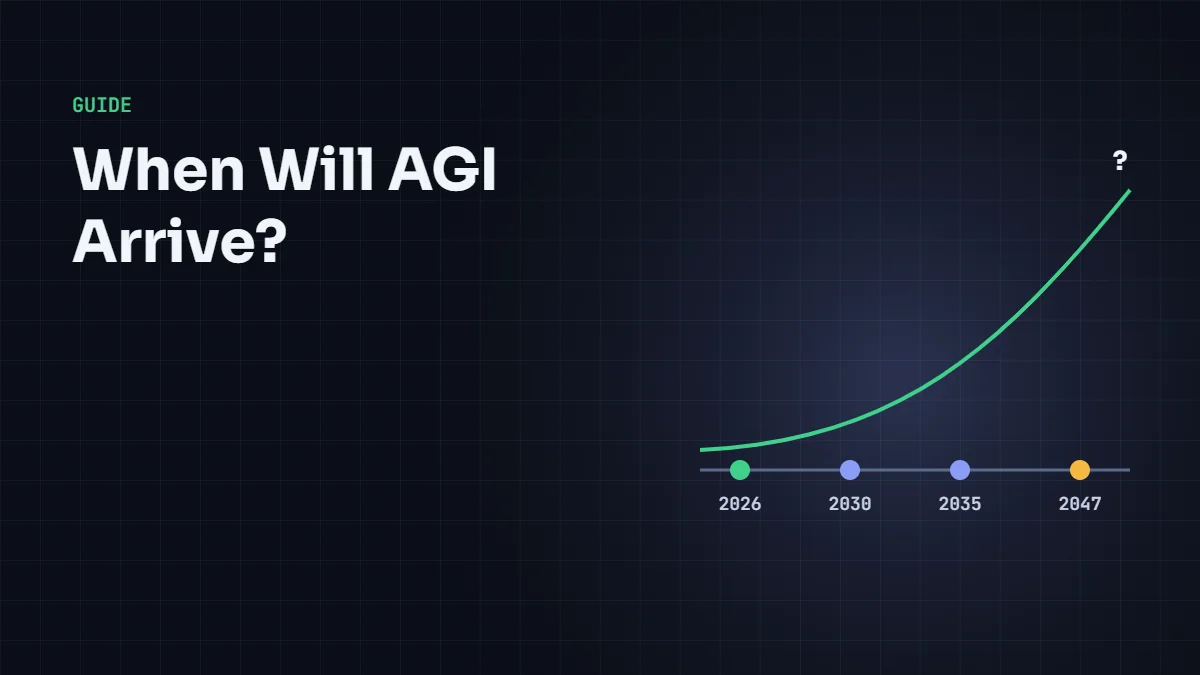
Nobody knows when AGI or superintelligence will arrive, and forecasts range from a few years to never. AI lab leaders have predicted AGI-level systems as early as the late 2020s. A 2023 survey of 2,778 AI researchers put a 50% chance on machines outperforming humans at every task by 2047, 13 years earlier than the same survey a year before. The authors of the AI 2027 scenario now put their median for AGI around 2030 to 2035. The biggest uncertainty is the intelligence explosion: whether AI that can do AI research would make progress accelerate sharply, or whether compute, power and data hold it back.
Forecasts at a glance
| Source | Forecast |
|---|---|
| AI lab leaders | Several have said AGI-level systems could arrive within a few years, some as early as 2026 to 2028 |
| AI Impacts survey of 2,778 researchers (2023) | 50% chance of AI outperforming humans at every task by 2047; full automation of all jobs much later |
| AI Futures Project (January 2026) | Median for AGI around 2030 (Daniel Kokotajlo) to 2035 (Eli Lifland) |
| Prediction markets and forecasting sites | Community forecasts for AGI have moved sharply earlier since 2020, now mostly in the late 2020s to 2030s, depending on the definition used |
| Sceptical researchers | Current methods may plateau; AGI could be decades away or need new breakthroughs |
Treat any single date with caution. Forecasts depend heavily on how AGI is defined. Read what is AGI for the competing definitions.
Why forecasts have moved earlier
Since 2020, AI capabilities have repeatedly arrived faster than experts expected. Language models went from writing paragraphs to passing professional exams, writing working software and solving olympiad-level maths problems in a few years. Researchers who track the length of tasks AI agents can complete on their own have found it doubling roughly every several months. Each surprise has pulled forecasts earlier.
What is the intelligence explosion?
The idea comes from mathematician I. J. Good, who wrote in 1965 that an "ultraintelligent machine could design even better machines", leading to an "intelligence explosion" that would leave human intelligence far behind. He called such a machine "the last invention that man need ever make".
In modern terms the loop looks like this:
1. AI becomes good enough to do AI research: writing code, running experiments, designing chips. 2. Labs run many copies of it, multiplying the number of "researchers". 3. Each new generation of AI is built faster than the last. 4. Progress goes from years per step to months, then weeks.
This is the engine of the AI 2027 scenario and a central idea in Nick Bostrom's Superintelligence.
What could slow it down
- Compute: more capable AI needs more chips. Chip factories and advanced packaging take years to expand. Read what is a GPU cluster.
- Power: frontier data centers now need hundreds of megawatts to gigawatts, and grid connections and power plants are slow to build. Read what is an AI data center.
- Data: high-quality human-written text is limited, so labs increasingly rely on synthetic data and learning from experience.
- Experiments in the real world: biology, materials science and robotics need physical experiments that cannot simply be sped up by faster thinking.
- Algorithms: today's methods may hit limits that need new ideas to overcome.
- Policy: regulation, export controls on chips, or a deliberate pause, as called for in the Statement on Superintelligence.
When would superintelligence follow AGI?
This is the most disputed question of all. In a fast takeoff, superintelligence could follow AGI within months, because AI research itself would be automated. In a slow takeoff, it could take many years, held back by the bottlenecks above. Some researchers think superhuman ability will arrive unevenly: superhuman at coding and maths long before superhuman at physical-world tasks. Read AGI vs ASI for the difference between the two.
How to judge new AGI predictions
- Check the definition. "AGI" in one forecast may mean passing exams; in another, doing every job.
- Look for track records. Forecasters who have been right before deserve more weight.
- Watch incentives. AI companies raising money and critics selling books both have reasons to lean one way.
- Follow the hardware. Data center and chip spending is the hardest evidence of what labs actually expect. Read our LLM training cost guide.
Frequently asked questions
When will AGI be achieved?
There is no consensus. Lab leaders suggest the late 2020s, surveyed researchers point to around the 2040s, and some sceptics think much later or never. Most forecasts have moved earlier in recent years.
What year will superintelligence arrive?
Forecasts are even more uncertain than for AGI. If an intelligence explosion happens, superintelligence could follow AGI quickly; if bottlenecks dominate, it could take decades.
Who coined the term intelligence explosion?
British mathematician I. J. Good, a former colleague of Alan Turing, in his 1965 paper "Speculations Concerning the First Ultraintelligent Machine".
Is AGI coming in 2027?
Probably not, according even to the authors of AI 2027, who described it as a faster-than-median scenario and have since moved their median forecasts to around 2030 to 2035.
Sources and further reading
- Katja Grace et al., Thousands of AI Authors on the Future of AI (AI Impacts survey, 2024)
- AI Futures Project, How our AI timelines forecasts have changed since AI 2027 (January 2026)
- METR, Measuring AI ability to complete long tasks (2025)
- I. J. Good, "Speculations Concerning the First Ultraintelligent Machine", Advances in Computers, 1965

Leave a Reply