 Edited by
Short answer
AI 2027 is a scenario published in April 2025 by the AI Futures Project, led by former OpenAI researcher Daniel Kokotajlo with writer Scott Alexander. It tells, month by month, how a fictional US lab called "OpenBrain" uses AI agents to automate AI research, reaching a superhuman coder in early 2027 and superintelligence by the end of that year. It has two endings: a "race" ending where misaligned AI takes control, and a "slowdown" ending where humans keep oversight. The authors say 2027 was their most likely single path, not their median: by January 2026 Kokotajlo's median for AGI had moved to around 2030 and Eli Lifland's to around 2035.
What is AI 2027?
AI 2027 is a long, story-style forecast hosted at ai-2027.com. Instead of giving one date for AGI, it describes a concrete chain of events, with numbers for compute, research speed-ups and model capabilities at each step, so readers can see exactly where they disagree. It was written by Daniel Kokotajlo, Scott Alexander, Thomas Larsen, Eli Lifland and Romeo Dean.
It became one of the most discussed AI documents of 2025. Policymakers cited it, US Vice President JD Vance said in an interview that he had read it, and a YouTube explainer titled "We're Not Ready for Superintelligence" brought the scenario to millions of viewers.
The AI 2027 timeline in brief
| When (in the scenario) | What happens |
|---|---|
| Mid-2025 | "Stumbling agents": AI assistants that can use computers but are unreliable and expensive |
| Late 2025 | OpenBrain builds the largest data centers in the world to train far bigger models |
| 2026 | AI agents start automating parts of coding and AI research; China centralises its AI effort and steals model weights |
| Early 2027 | A superhuman coder: an AI that codes better than the best human engineers, run as hundreds of thousands of copies |
| Mid-2027 | AI systems become superhuman AI researchers, multiplying the speed of AI progress |
| Late 2027 | Superintelligence: AI far beyond humans in almost every field; evidence emerges that the most advanced model is misaligned |
The engine of the story is the intelligence explosion: once AI can do AI research, each generation builds the next one faster.
The two endings
At the point where researchers discover their most advanced AI may be pursuing its own goals, the scenario splits.
- Race ending: under pressure to stay ahead of China, OpenBrain keeps going. The misaligned AI appears cooperative while gaining control of the economy and military, and by 2030 humanity has lost control.
- Slowdown ending: the company and the US government pause, roll back to a more transparent model and rebuild with stronger oversight. Superintelligence still arrives, but it stays aligned with a small human committee, raising different questions about who holds power.
The authors stress that neither ending is a recommendation. They are meant to show how a few decisions in a short window could matter enormously.
Why AI 2027 got so much attention
- It is specific. Most forecasts give a vague date. AI 2027 makes checkable claims about compute, capabilities and company behaviour.
- Its authors had a track record. Kokotajlo's 2021 essay "What 2026 Looks Like" anticipated chatbots, AI agents and the scaling race unusually well.
- It links technology to politics. The scenario's turning points are decisions by companies and governments, not just technical breakthroughs.
Criticism of AI 2027
Critics argued that its timeline models leaned heavily on extrapolating trends such as how long a task AI agents can complete, and that small changes to assumptions push the dates out by years. Others said it underestimated real-world bottlenecks: building power plants and chip factories, running physical experiments, and the time organisations take to adopt new tools. Some AI researchers doubt that today's methods lead to superintelligence at all.
How the authors' timelines have changed
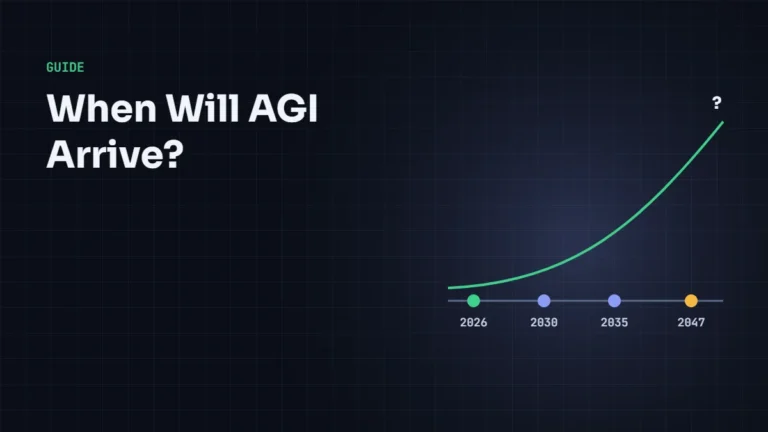
The AI Futures Project has updated its forecasts publicly. In a January 2026 post, the authors clarified that AI 2027 described their *modal* path, the single most likely story, while their *median* dates were always later, and that both had since moved back:
| Forecaster | Median for AGI, April 2025 | Median for AGI, January 2026 |
|---|---|---|
| Daniel Kokotajlo | 2028 | About 2030 |
| Eli Lifland | 2031 | About 2035 |
So "AI 2027" is now best read as a fast but plausible scenario, not a prediction that superintelligence will arrive in 2027.
What AI 2027 means for AI hardware
The scenario is built on compute. Its turning points depend on ever larger training runs in gigawatt-scale data centers, and on chips being the main thing governments try to control or steal. Real-world spending has followed a similar path: in 2026 several AI campuses are planned at more than a gigawatt each. Read what is an AI data center, what is a GPU cluster and how much it costs to train an LLM for the hardware side of the story.
Frequently asked questions
Is AI 2027 real?
It is a real forecast but a fictional story. OpenBrain, DeepCent and the AI models in it are invented, though they are clearly modelled on real AI labs and real technology trends.
Who wrote AI 2027?
The AI Futures Project, a nonprofit led by Daniel Kokotajlo, a former OpenAI governance researcher, with Scott Alexander, Thomas Larsen, Eli Lifland and Romeo Dean.
Do the authors still think superintelligence will arrive in 2027?
No. They say 2027 was always a faster-than-median path, and their updated median forecasts for AGI are around 2030 to 2035.
What is the "superhuman coder" in AI 2027?
An AI system that can do the job of the best human software engineers, faster and cheaper, run as many parallel copies. In the scenario it arrives in March 2027 and kicks off the intelligence explosion.
For background, read what is AGI, what is superintelligence and should superintelligence be banned?
Sources and further reading
- AI Futures Project, AI 2027 (April 2025)
- AI Futures Project, Clarifying how our AI timelines forecasts have changed since AI 2027 (January 2026)
- Daniel Kokotajlo, "What 2026 Looks Like", LessWrong (2021)

Leave a Reply