 Edited by
Short answer
AGI (artificial general intelligence) is AI that can match a capable human at most intellectual tasks, learning new ones without being rebuilt for each. ASI (artificial superintelligence) is AI that greatly exceeds the best humans in virtually every field, from science to strategy. Today's systems are narrow AI (ANI) or, by some definitions, early AGI. AGI is the point where AI becomes our equal; ASI is where it becomes far more capable than us. Many researchers expect that once AGI exists it could help build ASI quickly, which is why safety research focuses on the step between them.
ANI, AGI and ASI: the three levels
| ANI (narrow AI) | AGI (general AI) | ASI (superintelligence) | |
|---|---|---|---|
| Ability | Excellent at one task or a family of tasks | Roughly human level across most cognitive tasks | Far beyond the best humans in almost every domain |
| Learning | Trained for its task | Learns new tasks like a person would | Could improve itself and its own designs |
| Examples | Chess engines, image classifiers, spam filters, recommendation systems | Not agreed; some argue frontier language models are early AGI | None exist |
| Status in 2026 | Everywhere | Debated and actively pursued | Hypothetical; the stated goal of several labs |
What is AGI?
There is no single agreed definition, which is why claims that AGI has or has not arrived often talk past each other. The common ones:
- OpenAI's charter: "highly autonomous systems that outperform humans at most economically valuable work."
- Capability view: a system that can do any intellectual task a typical adult can, including learning skills it was not trained for.
- Google DeepMind's "Levels of AGI" (2023): rates systems by performance and generality on a scale of Emerging, Competent, Expert, Virtuoso and Superhuman. On this scale, today's chatbots are "Emerging AGI": general, but only at or somewhat above unskilled human level on many tasks.
The DeepMind framework is useful because it treats AGI as a range, not a single moment. "Superhuman" at the top of its scale is essentially ASI.
What is ASI?
Philosopher Nick Bostrom, in his 2014 book *Superintelligence*, defined it as "any intellect that greatly exceeds the cognitive performance of humans in virtually all domains of interest." That covers scientific creativity, general wisdom and social skills, not just calculation. An ASI would not just answer questions faster; it could make discoveries, design technologies and plan in ways no human team could follow in detail.
Read what is superintelligence for a full explanation of the idea, and Safe Superintelligence (SSI) explained for the company built around it.
AGI vs ASI: the key differences
- Benchmark: AGI is measured against humans; ASI is measured against all of humanity's best experts combined, and beats them.
- Who checks whom: we can still evaluate an AGI's work. Checking an ASI's work may be beyond us, which is the core of the alignment problem.
- Self-improvement: an AGI that is as good as top AI researchers could speed up AI research itself. Mathematician I. J. Good described this in 1965 as an "intelligence explosion": a machine that improves its own design, leading to ever smarter machines.
- Impact: AGI would transform work and the economy. ASI would change who, or what, is making the most important decisions.
How could AGI lead to ASI?
The most discussed path is recursive self-improvement. If AI systems become good enough to do AI research, they can design better models, write better training code and find better chips, and each improvement makes the next one faster. Several frontier labs already use AI heavily in writing their own software.
Two things could slow this down. First, compute: training and running smarter models needs more chips, power and data centers, which take years to build. Second, data and experiments: real-world science needs physical experiments that cannot be sped up just by thinking faster. This is why AI hardware is central to the question.
What hardware would AGI and ASI need?
Nobody knows the exact amount, but the trend is clear. Each new generation of frontier models has been trained on more compute than the last, and labs are building data centers measured in gigawatts, with hundreds of thousands to millions of GPUs and custom chips such as Google's TPUs. Read what is an AI data center, what is a GPU cluster and how much it costs to train an LLM for what this looks like today, and what is a Tensor Core for the circuits doing the maths.
When will AGI and ASI arrive?
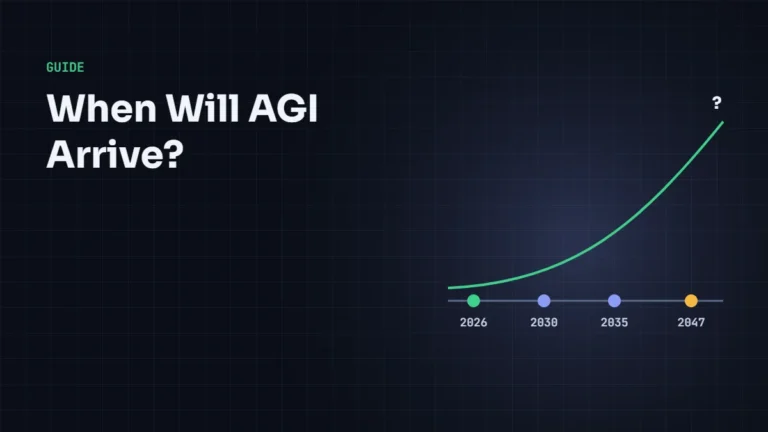
Forecasts vary enormously. Some AI lab leaders have said they expect AGI-level systems within a few years; many academic researchers expect decades, and some doubt current methods will get there at all. Forecasts for ASI depend mostly on how fast the step from AGI would be, which ranges from months to never in different expert views. Treat any precise date with caution.
Related: what is AGI, when will AGI arrive?, AI 2027, should superintelligence be banned? and AI safety in Australia.
Frequently asked questions
Is ChatGPT AGI?
Not by most definitions. Large language models are general across many tasks but still make basic errors, cannot reliably learn new skills on their own and struggle with long, open-ended work. Under Google DeepMind's framework they count as "Emerging AGI". Read how AI works to see why.
Is ASI the same as the singularity?
They are related. The technological singularity is the idea of a point after which progress becomes so fast and unpredictable, usually because of superintelligent AI, that the future cannot be forecast. ASI is the technology; the singularity is one theory of what it would cause.
Which comes first, AGI or ASI?
AGI. By definition ASI exceeds human level, so a system would pass through human-level general ability on the way, even if only briefly.
Is AGI dangerous?
It could be, mainly through misuse, accidents and loss of human control as systems become more capable. Those risks grow with ASI, which is why labs such as SSI, Anthropic, OpenAI and Google DeepMind run alignment and safety research.
Sources and further reading
- Google DeepMind, Levels of AGI: Operationalizing Progress on the Path to AGI (2023)
- OpenAI, OpenAI Charter
- Nick Bostrom, Superintelligence: Paths, Dangers, Strategies (Oxford University Press, 2014)
- I. J. Good, "Speculations Concerning the First Ultraintelligent Machine", Advances in Computers, 1965

Leave a Reply