 Edited by
Short answer
An intelligence explosion is a hypothetical runaway process in which an AI system becomes good enough at AI research to improve itself, and each improved version improves the next one faster, quickly leading to superintelligence. The idea was set out by mathematician I. J. Good in 1965 and is closely linked to the technological singularity. Researchers disagree about whether it would happen in days (a "fast takeoff") or over years, or whether limits on compute, data and experiments would slow it down. AI is already helping with parts of AI research, which is why the question is now taken seriously.
Where the idea comes from
In 1965, the British mathematician I. J. Good, who had worked with Alan Turing at Bletchley Park, wrote "Speculations Concerning the First Ultraintelligent Machine." He argued that a machine able to surpass humans at all intellectual activities could also design better machines, since designing machines is one of those activities. That would trigger an "intelligence explosion," leaving human intelligence far behind. He famously called the first such machine "the last invention that man need ever make," provided it was docile enough to keep under control.
In 1993, science fiction author and mathematician Vernor Vinge popularised the term technological singularity in his essay "The Coming Technological Singularity," predicting superhuman intelligence within about 30 years. Ray Kurzweil's 2005 book The Singularity Is Near forecast the singularity around 2045. Nick Bostrom's 2014 book Superintelligence analysed how such a takeoff might unfold and why it could be dangerous.
How recursive self-improvement would work
The core loop is simple:
- An AI system becomes capable enough to do useful AI research and engineering.
- It designs a better version of itself: better algorithms, training methods, data or chips.
- The better version is an even better AI researcher, so it makes the next improvement faster.
- Repeat. If each step's gains outweigh the growing difficulty of further improvements, progress accelerates.
The improvement does not have to come from a single AI rewriting its own code. It could be thousands of copies of an AI model working as automated researchers, running experiments around the clock. That is the scenario described in forecasts such as AI 2027.
Fast takeoff vs slow takeoff
| Fast takeoff | Slow (gradual) takeoff | |
|---|---|---|
| Timescale | Hours to months | Years to decades |
| What drives it | Strong feedback loop, few bottlenecks | Gains limited by compute, data, experiments, economics |
| Warning signs | Little time to react | Visible progress, time to adapt and regulate |
| Who argued for it | Eliezer Yudkowsky and others | Paul Christiano, many economists |
Bostrom distinguished fast, moderate and slow takeoffs and argued that the speed matters enormously: a slow takeoff gives society time to notice problems, while a fast one could leave a single project with a decisive advantage.
Arguments that an intelligence explosion could happen
- Software is copyable: once an AI can do research, you can run many copies in parallel, unlike human researchers.
- Speed: AI systems already think and type far faster than people.
- Algorithms keep improving: research has found that the compute needed to reach a given level of performance has fallen quickly year after year, separate from hardware gains.
- AI is already helping: coding assistants write much of the code at some AI labs, and systems like Google DeepMind's AlphaEvolve (2025) discovered improved algorithms, including a faster way to multiply 4 × 4 complex matrices and optimisations that sped up parts of Gemini's own training.
Arguments against (or for a slower path)
- Compute bottlenecks: each improvement may need large training runs and experiments, which take time and hardware. Even a brilliant AI researcher has to wait for results.
- Diminishing returns: each improvement may be harder than the last, so the loop slows instead of speeding up.
- Data and real-world feedback: some progress needs real-world data and experiments that cannot be sped up arbitrarily.
- Physical limits: building chips, data centers and power plants takes years.
- Intelligence may not be a single dial: being better at AI research does not automatically make a system better at everything.
Why it matters for safety
If an intelligence explosion is possible, the most important moment is the start, when humans still have control. A system that improves itself quickly might develop goals or capabilities its creators did not intend, and there may be little time to correct course. This is why many researchers argue that AI alignment must be solved before AI can substantially automate AI research, and why frontier labs now monitor "AI R&D" capabilities in their safety frameworks as a key risk threshold.
Has the intelligence explosion started?
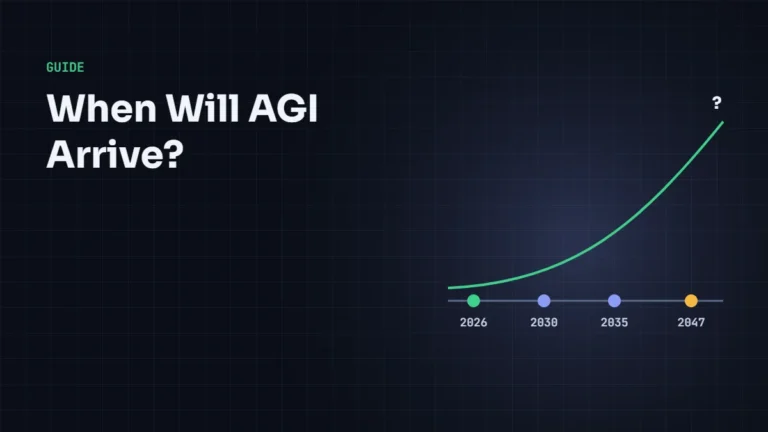
Not in the full sense. AI does not yet independently design and train its own successors. But the ingredients are being assembled: AI writes a growing share of code, helps run experiments and contributes to chip design. Leaders of major labs have said they aim to build automated AI researchers within the next few years. Whether that leads to a sudden explosion or a steep but manageable climb is one of the most debated questions in AI. See when will AGI arrive for current forecasts.
Frequently asked questions
What is the difference between the intelligence explosion and the singularity?
The intelligence explosion is the mechanism: AI rapidly improving itself. The singularity usually refers to the result: a point after which technological change is so fast and profound that the future becomes impossible to predict.
Who first proposed the intelligence explosion?
I. J. Good, in his 1965 paper "Speculations Concerning the First Ultraintelligent Machine."
Is an intelligence explosion inevitable?
No. It depends on whether AI can do AI research effectively and whether bottlenecks such as compute slow the feedback loop. Experts disagree widely.
Sources and further reading
- I. J. Good, "Speculations Concerning the First Ultraintelligent Machine," Advances in Computers, 1965
- Vernor Vinge, The Coming Technological Singularity (1993)
- Nick Bostrom, Superintelligence: Paths, Dangers, Strategies, Oxford University Press, 2014
- Google DeepMind, AlphaEvolve: A Gemini-powered coding agent for designing advanced algorithms (2025)

Leave a Reply