 Edited by
Short answer
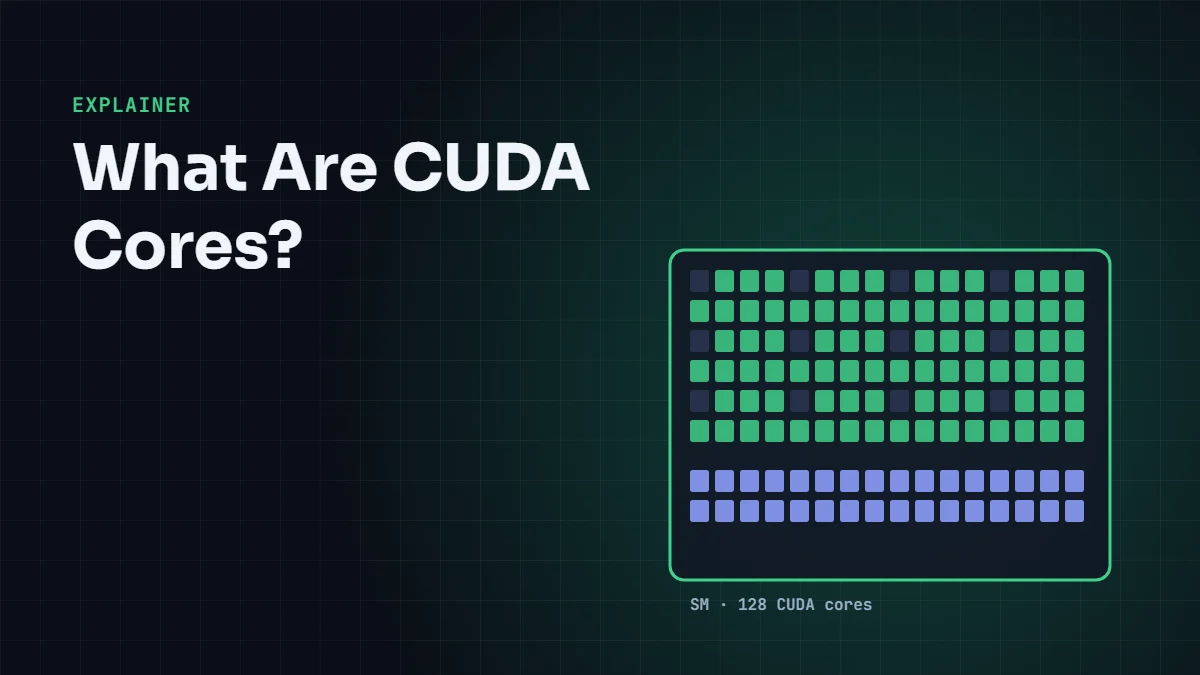
A CUDA core is NVIDIA's name for one 32-bit floating-point arithmetic unit inside its GPUs. It is not a full processor like a CPU core: it is one lane that does one multiply-add per clock, and it works in lockstep with 31 others as a "warp". NVIDIA groups 128 of them into each streaming multiprocessor (SM) on recent GPUs, so the RTX 5090's 170 SMs give it 21,760 CUDA cores. CUDA cores run general GPU work such as shading, physics and the non-matrix parts of AI; the heavy matrix maths in AI runs on separate Tensor Cores.
What a CUDA core is
NVIDIA started calling its GPU arithmetic units "CUDA cores" with the Fermi architecture in 2010, borrowing the name of its CUDA programming platform. Each one is a pipelined arithmetic logic unit that can do one fused multiply-add on 32-bit floating-point numbers (FP32) per clock cycle. That is it. It has no instruction fetch of its own, no branch predictor and no cache of its own.
Compare that with a CPU core, which fetches and decodes its own instructions, predicts branches, runs instructions out of order and has its own caches. A CPU core is a complete, independent processor. A CUDA core is closer to one lane of a CPU's vector unit. So a GPU with 21,760 CUDA cores is not "a 21,760-core computer" in the CPU sense; it is a chip with 170 independent processors (the SMs), each with very wide vector hardware.
How CUDA cores are organised: SMs, partitions and warps
The building block of an NVIDIA GPU is the streaming multiprocessor (SM). On every architecture since Ampere's consumer chips (RTX 30), each SM contains:
- 4 processing blocks (partitions), each with 32 FP32 lanes, so 128 CUDA cores per SM
- 4 Tensor Cores, one per partition, for matrix maths
- 1 RT core for ray tracing on GeForce and RTX workstation chips
- A shared register file, L1 cache and shared memory, plus warp schedulers
The GPU does not schedule CUDA cores one by one. It schedules warps: groups of 32 threads that execute the same instruction at the same time on different data. Each partition's warp scheduler issues one warp instruction per clock to its 32 lanes. This model is called SIMT (single instruction, multiple threads). If threads in a warp take different branches of an if, the warp runs both paths one after the other with some threads switched off, which is why branchy code is slow on GPUs. Read how a GPU works for the full picture of SMs, warps and memory.
The core count on a spec sheet is simply SMs × FP32 lanes per SM. The RTX 5090 has 170 SMs × 128 = 21,760. The H100 SXM has 132 SMs × 128 = 16,896.
CUDA core counts of popular NVIDIA GPUs
| GPU | Architecture | SMs | CUDA cores | Tensor Cores |
|---|---|---|---|---|
| GeForce RTX 5090 | Blackwell | 170 | 21,760 | 680 (5th gen) |
| GeForce RTX 5080 | Blackwell | 84 | 10,752 | 336 (5th gen) |
| GeForce RTX 5070 Ti | Blackwell | 70 | 8,960 | 280 (5th gen) |
| GeForce RTX 5070 | Blackwell | 48 | 6,144 | 192 (5th gen) |
| GeForce RTX 4090 | Ada Lovelace | 128 | 16,384 | 512 (4th gen) |
| GeForce RTX 3090 | Ampere | 82 | 10,496 | 328 (3rd gen) |
| NVIDIA H100 SXM | Hopper | 132 | 16,896 | 528 (4th gen) |
| NVIDIA A100 | Ampere | 108 | 6,912 | 432 (3rd gen) |
The A100 stands out: it has 108 SMs but only 64 FP32 lanes per SM, because its SM spends silicon on FP64 units and large Tensor Cores instead. That is one reason raw CUDA core counts mislead.
Why you cannot compare CUDA cores across generations
More CUDA cores within one generation usually means a faster card: an RTX 5080 beats an RTX 5070 largely because it has 75% more of them. Across generations the count stops being meaningful, for three reasons.
- The definition changed. Ampere doubled the FP32 lanes per SM, but half of them share hardware with integer (INT32) work. When a game mixes in integer instructions, those lanes do integer work instead. The RTX 3080's 8,704 CUDA cores did not deliver twice the performance of the RTX 2080 Ti's 4,352.
- Clock speed differs. Throughput is cores × clock × 2 operations per multiply-add. The RTX 5090's 21,760 cores at a 2.41 GHz boost give about 105 TFLOPS of FP32.
- Other units matter more. Cache size, memory bandwidth, Tensor Cores and RT cores often decide real performance. The RTX 4090 beats the RTX 3090 by far more than its 56% core increase, largely thanks to a much bigger L2 cache and higher clocks.
The same applies when comparing with AMD. AMD counts "stream processors" (64 per compute unit) and, since RDNA 3, those units can dual-issue some instructions, so neither company's number maps neatly onto the other's.
CUDA cores vs Tensor Cores vs RT cores
Modern NVIDIA GPUs have three kinds of execution unit, and each is built for a different job.
| Unit | What it does | Used for |
|---|---|---|
| CUDA core | One FP32 (or INT32) multiply-add per clock per lane | Shading, physics, video effects, general compute, and AI operations such as activations, softmax and normalisation |
| Tensor Core | A whole small matrix multiply-accumulate per clock, at FP16, BF16, FP8, FP4 and other low precisions | Matrix multiplies in AI training and inference, DLSS |
| RT core | Ray–triangle and ray–box intersection tests | Ray tracing in games and renderers |
For AI the difference is huge. On an RTX 5090 the CUDA cores deliver about 105 TFLOPS of FP32, while the Tensor Cores deliver about 419 TFLOPS of dense FP16 and far more at FP8 and FP4. Read Tensor Cores vs CUDA Cores for a deeper comparison and Tensor Cores vs RT cores for ray tracing.
Do CUDA cores matter for AI?
Less than the spec sheet suggests. In a transformer model, almost all the arithmetic is matrix multiplication, and that runs on Tensor Cores. CUDA cores handle everything around it: applying activation functions, computing softmax in attention, layer normalisation, adding residual connections, and moving and reshaping data. These steps are cheap in operations but read and write a lot of memory, so they are usually limited by memory bandwidth rather than core count.
That is why, when choosing a GPU for running models locally, VRAM capacity and memory bandwidth come first, Tensor Core generation (for FP8 and FP4 support) second, and CUDA core count a distant third. Read what is VRAM and the best GPU for local LLMs before you buy.
What does "CUDA" have to do with CUDA cores?
CUDA (Compute Unified Device Architecture) is NVIDIA's platform for programming GPUs in C, C++, Python and other languages, launched in 2007. It is software: a compiler, runtime, drivers and libraries like cuBLAS and cuDNN. CUDA cores are hardware. The name links them because CUDA programs run their threads on those cores. Every NVIDIA GPU since the GeForce 8800 runs CUDA code, and AMD and Intel GPUs do not run it natively. Read what is CUDA or start coding with our CUDA volume in the language library.
How many CUDA cores do you need?
- 1080p and 1440p gaming: a current mid-range card with around 4,000 to 7,000 CUDA cores (RTX 5060 Ti to RTX 5070 class) is enough; VRAM and DLSS support matter as much as core count.
- 4K gaming and heavy ray tracing: 8,000 to 11,000 cores (RTX 5070 Ti to RTX 5080) or more.
- Video editing and 3D rendering: more cores speed up GPU renderers like Blender Cycles and OptiX almost linearly, so the biggest card you can afford helps.
- Running AI models locally: buy for VRAM first. A 16 GB card with fewer cores will run models that an 8 GB card with more cores cannot load at all.
Frequently asked questions
Is a CUDA core the same as a CPU core?
No. A CPU core is a full independent processor. A CUDA core is a single arithmetic lane that executes as part of a 32-thread warp inside an SM. The closest GPU equivalent of a CPU core is the SM.
Does AMD have CUDA cores?
No. CUDA cores are NVIDIA's term. AMD's equivalent units are called stream processors, grouped into compute units, and Intel's are called Xe vector engines. The numbers are not directly comparable between brands.
Do more CUDA cores mean better performance?
Within the same generation, usually yes. Across generations or brands, not reliably, because clock speed, cache, memory bandwidth and the design of each core all change.
Do CUDA cores do FP64?
Not in the usual sense. Double-precision (FP64) runs on separate FP64 units. GeForce cards have very few of them (1/64 of the FP32 rate), while data-center chips like the H100 have many more.




Leave a Reply