Guides
Plain-language guides to AI hardware concepts: precision formats, quantization, sparsity, FLOPS and how to read a GPU spec sheet.
Practical guides for choosing and using AI hardware
Guides for people choosing, buying or using AI hardware: which GPU runs which model, how much memory you need, what training costs, and how to read the performance numbers vendors publish.
Running models at home? Start with the first three. Planning training or comparing chips? Jump to the cost and TOPS guides.
Start here
Tools for this topic
Edited by Sami Ullah Khan. Read our editorial policy.
All Guides articles
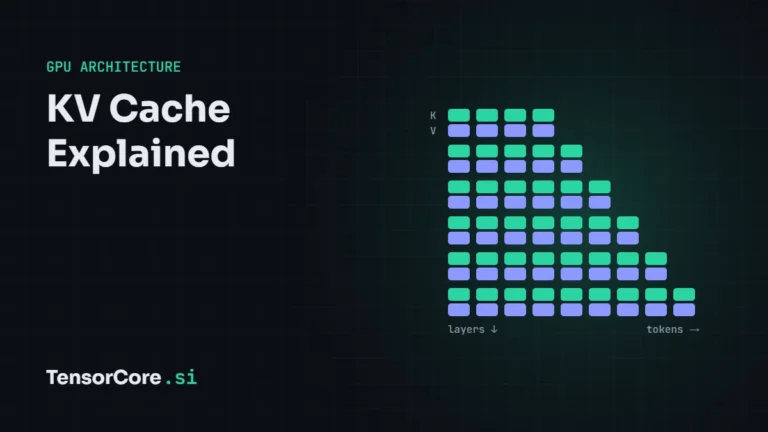
KV Cache Explained: Why Long Context Uses So Much Memory
The KV cache stores keys and values for every past token. The formula, sizes for Llama, Qwen and DeepSeek, GQA vs MLA, and how…
Best GPU for Running LLMs Locally (2026 Guide)
VRAM decides which models you can run and bandwidth decides speed. GPUs and Macs compared for Llama, Qwen, DeepSeek and gpt-oss, with VRAM needs…
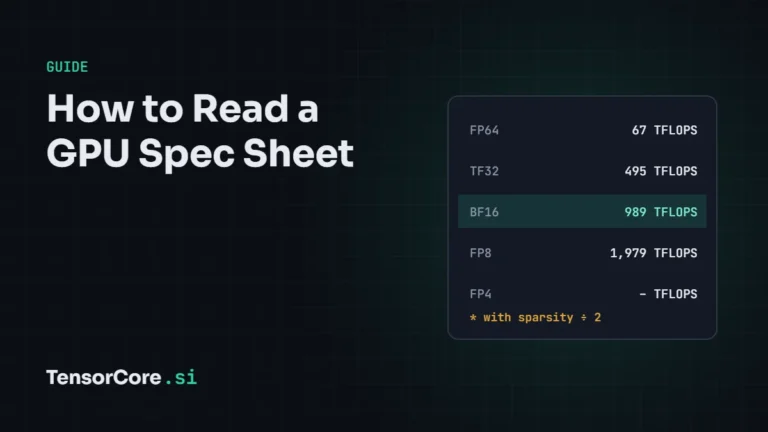
How to Read a GPU Spec Sheet: TFLOPS, Sparsity and Memory
Dense vs sparse TFLOPS, per-GPU vs per-server figures, SXM vs PCIe, memory bandwidth, the peak FLOPS formula and how to estimate real training time…
What Is a Tensor Core? A Plain-Language Guide
A Tensor Core is the matrix-math engine inside NVIDIA GPUs. Here is what it computes, why AI depends on it, and how it went…
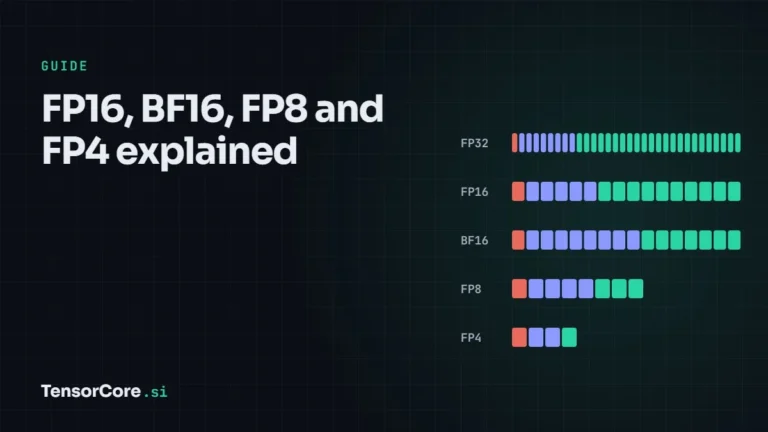
FP16, BF16, FP8 and FP4: Precision Formats Explained
Why AI runs on 16-, 8- and even 4-bit numbers, how each format trades range for precision, and what microscaling, NVFP4 and FP32 accumulation…